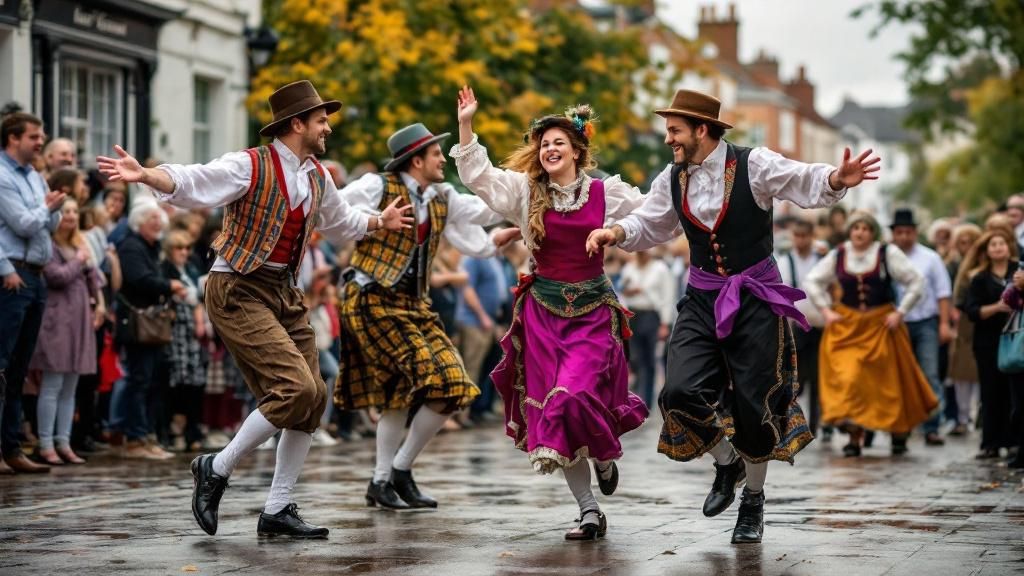

Once overlooked as a nostalgic echo of England’s rural heritage, Morris dancing is experiencing an remarkable comeback amongst Britain’s youth. From university societies to rural commons, devotees under the age of thirty are reconnecting with the rhythmic footwork, jingling bells, and colourful costumes that have characterised this long-established practice. This article investigates the reasons behind this artistic renaissance, considers how contemporary performers are reimagining the form, and investigates what this renewed interest reveals about current British views towards cultural legacy and collective identity.
The Revival of Morris Dance
The revival of Morris dancing amongst young people across Britain represents a notable move from years of falling participation. What was once considered an exclusively rural or elderly pursuit has evolved into a dynamic cultural phenomenon, with university societies, metropolitan dance collectives, and local organisations actively embracing the tradition. This resurgence challenges long-held stereotypes and proves that young people today truly recognise the worth of maintaining and honouring Britain’s folkloric heritage, revitalising practices that appeared headed toward obscurity.
This renewed enthusiasm goes further than simple nostalgic interest; younger dancers are consciously reimagining Morris dancing for today’s world. They incorporate contemporary music, experiment with creative movement patterns, and create welcoming groups that embrace dancers irrespective of social background or dance experience. The movement demonstrates a more expansive cultural transformation wherein young British people deliberately look for real ties to their cultural background whilst concurrently reconceiving the meaning of tradition, establishing a living conversation between historical authenticity and modern artistic interpretation that resonates with the values of their generation.
Why Young People Are Taking Up This Classic Artistic Practice
Morris dancing’s draw among younger generations transcends nostalgic curiosity. Contemporary dancers appreciate the art form’s deep cultural roots whilst acknowledging its ability to enable creative expression and social connection. The ease of access to modern Morris groups, coupled with their open-minded values, has shifted the view of this historically exclusive pursuit. Young people are finding that Morris dancing offers a worthwhile substitute to standard recreational pursuits, affording both bodily exertion and real communal involvement in an increasingly digital world.
Sense of Community
In an period marked by community breakdown, Morris dancing groups offer young people with concrete social networks founded on common principles and collaborative practice. The inclusive nature of contemporary Morris groups readily embraces newcomers irrespective of background or experience, nurturing genuine friendships and social bonds. Participants often describe their dancing cohorts as family units of choice, providing emotional support and a sense of place that extends well beyond the dancing calendar. This sense of community becomes particularly valuable for young adults managing university or early career transitions.
The cooperative design of Morris dancing inherently fosters collective togetherness and reciprocal obligation. Each dancer’s participation directly influences the group’s aesthetic coordination and rhythmic precision, creating mutual reliance that strengthens community ties. Many young dancers note that their Morris groups enable genuine relationships in ways that traditional social environments often fail to accomplish. The joint investment to sustaining and advancing this established custom creates a compelling awareness of shared mission amongst members.
Bodily Activity and Overall Wellbeing
Morris dancing demands substantial bodily effort, combining cardiovascular exercise with intricate movement control and muscular conditioning. Young dancers benefit from enhanced physical capability whilst participating in activity that carries cultural significance rather than simply functional. The repetitive, rhythmic character of Morris footwork provides meditative qualities alongside physical conditioning, contributing positively to mental wellbeing. Participants frequently cite the comprehensive wellness advantages as a primary motivation for sustained involvement in their local Morris groups.
Beyond cardiovascular benefits, Morris dancing cultivates proprioceptive awareness and physical self-assurance, particularly valuable for young people struggling with body image worries. The focus on technical precision and group coordination shifts attention away from appearance-based concern toward capability and achievement. Moreover, the outdoor performance tradition associated with Morris dancing encourages participants to engage with the natural world and the rhythms of the seasons, promoting mental health through connection with the natural world and cultural heritage.
Regional Variations and Modern Adaptations
Morris dancing practices differ considerably across Britain’s localities, with each area developing characteristic forms capturing community traditions and geographical features. The Cotswolds preserve the robust, athletic “Cotswold” approach, whilst the North West favours the more elaborate “Northwest” tradition featuring intricate dress and detailed arrangements. Emerging performers are actively adopting these local styles, engaging in instruction and festivals to learn genuine methods whilst recognising the subtle cultural elements contained in each style. This spatial range offers present-day artists with various pathways into Morris dancing, allowing them to connect with heritage rooted in their local areas.
Modern adaptations are simultaneously broadening Morris dancing’s reach outside traditional contexts. Younger enthusiasts integrate contemporary music, experimental choreography, and inclusive casting practices, questioning historical gender and age restrictions. All-gender ensembles and LGBTQ+ Morris groups have emerged, fundamentally reshaping the tradition’s social dynamics. These innovations preserve the essential character—rhythmic footwork, bells, and celebratory spirit—whilst rendering the practice more accessible and relevant to contemporary participants. Such imaginative reimagining illustrates that heritage traditions needn’t remain static, successfully bridging historical authenticity with modern sensibilities.
The Evolution of Morris Dancing in the United Kingdom
As Morris dancing remains popular with younger audiences, the tradition stands at a pivotal juncture. Contemporary dancers are consciously redefining the form whilst respecting its traditional roots, creating innovative routines and accessible methods that resonate with modern sensibilities. Universities document unprecedented enrolment in Morris societies, whilst festivals draw record crowds of young participants. This momentum suggests the art form is transitioning from nostalgic curiosity to legitimate contemporary practice, building lasting structures for continued expansion and lasting significance within British communities nationwide.
Looking ahead, Morris dancing’s trajectory appears notably encouraging. The intersection of social media promotion, easy-to-follow learning techniques, and younger generations’ appetite for authentic communal bonds creates optimal environments for thriving. Organisations are supporting apprenticeship schemes and regional competitions, fostering talent pipelines and enabling skill transmission between seasoned and emerging dancers. Should this enthusiasm endure, Morris dancing may finally shed its perception as exclusively historically-oriented, instead becoming acknowledged as a vibrant, evolving cultural practice that substantially enhances contemporary British society and reinforces community ties across generations.
